Should CV Be Full Folio?
Should biographies be full folio? A biography specialist explains
Employment-seekers often get confused about the optimal Curriculum Vitae length. You've probably heard the famous 'six second rule', according to which a biography has to be concise and sell the candidate in mere seconds. However, in certain cases a single sheet resume is simply not enough - and can jeopardize your interview chances. In today's article, our portfolio consultant is going to reveal when to utilize a traditional single-folio Curriculum Vitae. We will also explain when it's reasonable to present a two- or three-sheet file. Read here about handwritten profile. Looking for a first vita guide? Check here!
Stuck with biography writing? Our website offers pro bio services for all occupation levels. The skilled author will prepare a Curriculum Vitae tailored for your business goals and optimized for applicant tracking systems. Each paper is written from scratch by the author who understands your industry and delivered to you according to the deadline you've chosen.
Statistics on single- and two-folio documents
Before we get down to determining perfect Curriculum Vitae length for each particular situation, let's take a look at the situation in general. Companies receive 250+ files for each advertised position posting. Out of this amount, only up to six candidates get interviews. Therefore, to get shortlisted, you have to submit a strong Curriculum Vitae aligned with the work description.
Speaking of length, hiring managers are 1.4x more likely to choose a candidate with a two-folio doc. Can my vita be 1.5 sheets? Obviously, to many recruiters, two sheets signify a more knowledgeable, more skilled applicant.
Number of words matters as well. As stated by another research, the optimal word count is up to 600 words. This highlights the importance of cutting off the unnecessary despite the folio count.
These quick findings suggest that using a two-folio Curriculum Vitae is okay, but you need to watch the word count to keep it focused. Next, we'll look at how many sheets should every candidate present, depending on the state of their occupation.
When is a full-folio doc your ideal choice?
Hiring manager will appreciate a short bio if:
- You are a college graduate with limited expertise related to your target position
- You are a career switcher (say, from teaching to IT) and your previous practice has nothing to do with the new industry
- You have under 10 years of expertise or up to 4 employers.
This is a portfolio of a Digital Marketing Specialist with 4 years' practice. The candidate had three positions, so using a two-sheet bio is unnecessary. Despite being short, this bio is informative enough about the candidate's strengths, work history and education.
A two-page portfolio is optimal when:
- You are a college graduate with several internships, summer employment, or extracurricular activities that provided you with relevant skills
- Your occupaiton requires narrow technical or industry-specific skills, and candidates without these skills are not even considered for the role
- You have 10+ years of practice in the given industry under your belt
- You are a C-level manager with a broad list of achievements, projects managed, and wide organizational impact
- Your field appreciates specialized training, licences, academic publications and achievements.
Here's a perfect template that is 2 sheets long:
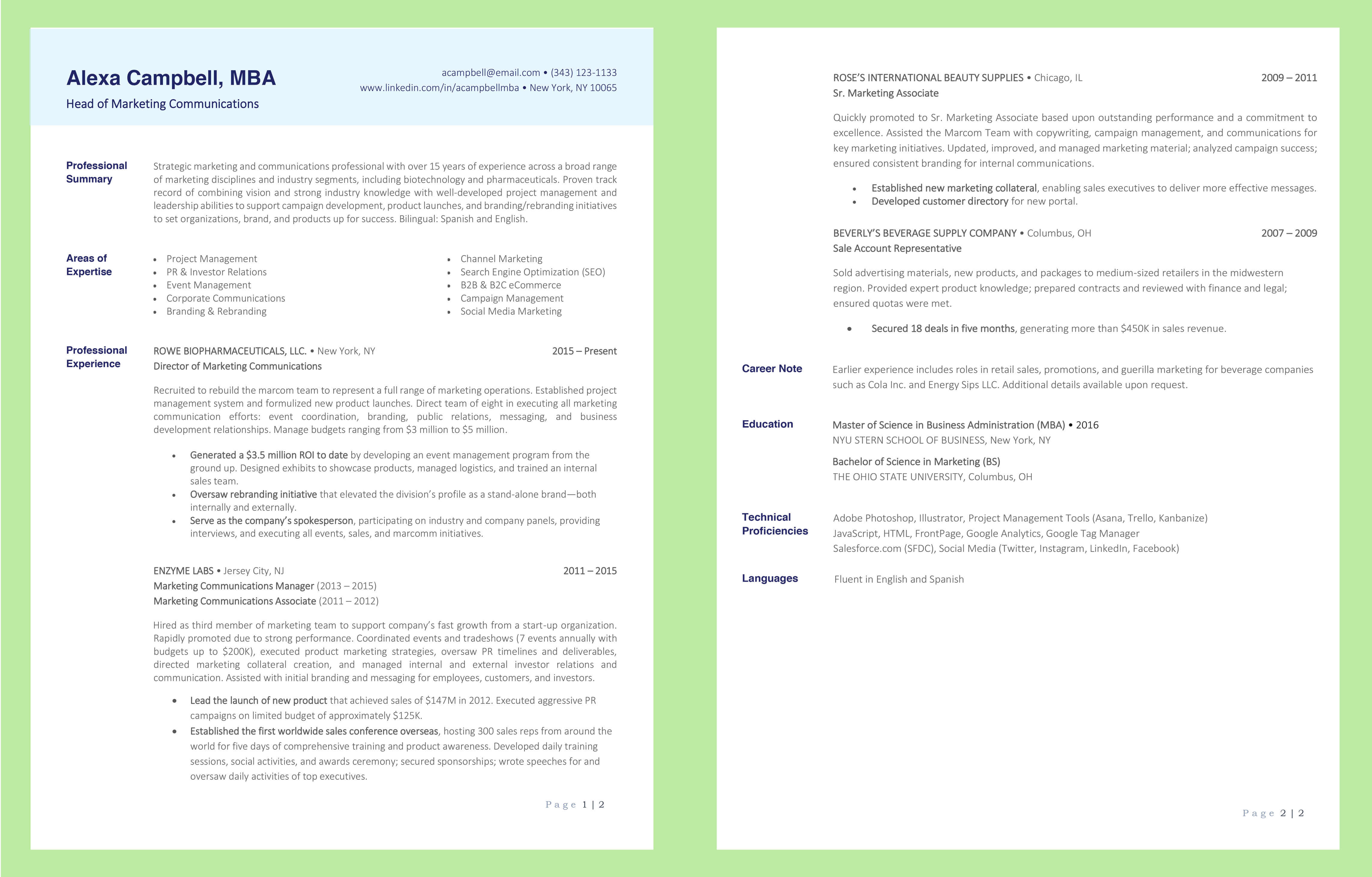
This is a Curriculum Vitae of a skilled senior-level pro, Head of Marketing. The file is focused on relevant expertise only and shows career progression. More imporantly, it emphasizes accomplishments, which is crucial for senior specialists.
As you see, there's no universal answer to "Should career document be one page?" If you have an extensive career history, an impressive list of skills and certifications, the second folio is perfectly excused. On the flip side, applicants should not pack the profile with unimportant facts just to make it longer. If you've been on the employment market for a couple of years, having only full page is fine.
When to introduce a three-folio or longer portfolio?
Some jobs require application with a curriculum vitae - a multiple folio doc that contains information about your education, employment and research. A vita can take five or even ten pages, and the more is better. When it doubt, clarify with your employer if they expect a portfolio or a vita.
Is a 1.5 sheet biography acceptable?
According to resume consultants and certified Curriculum Vitae biographer, it's no recommended to leave the half of the second folio empty. It can leave an impression that you stopped halfway in writing. Change the font and formatting, so that the text takes 1 or 2 full sheets - it will make a better visual impression on most hiring managers.
How to fit your profile into a page?
Disclaimer: we do not state that single-folio bio is a must. However, if you feel that your file lacks focus, or if the recruiters recommend shortening it, you might want to reconsider the content. Below, we will give the recommendations about what to remove to keep the paper informative for potential employer.
Remove the unnecessary sections
Specialists recommend that you delete old or irrelevant occupations, education, and training. If you don't have much practice relevant to your position target, simply list the skills you have acquired in various jobs to save space.
The same goes for "References available upon request". This statement is dated and says nothing to the hiring manager.
Cut down the bullet points
If you have worked in the same industry, you might notice that some bullets with responsibilities look very similar. You can cut down similar responsibilities for different employers to avoid duplication and to prevent wasting precious space. Mention a specific employment responsibility once, and then focus on those that add the extra information.
Also, to avoid sounding repetitive, focus on results over occupation duties. They may include awards, recommendations, or measurable accomplishments in a specific role.
Keep the resume summary concise
Career summary is a helpful section that quickly introduces your selling points to the employer. However, many career-seekers create long paragraps that take a lot of space. In fact, 2-3 sentences are enough to introduce you to the company and show what you excel at.
Focus on relevant job practice
To prioritize your work history and choose the most important facts for your target position, make a master list of your credentials and achievements. Only include those that are directly related to the position you are applying for.
Speaking of education, if you got at least Associate's degree, high school diploma is no longer relevant. Similarly, if you have 5+ years of expertise, remove the college coursework and extracurricular activities as employer mind your work history at this point.
List contact details in a line
A line after your name is enough to place your location, email, and a cell number. No need to start each of them in a separate line. This simple trick is very helpful in creating a single-sheet biography.
Include relevant information when listing leadership experience
No need to describe all summer jobs, trainings, extracurricular activities, and awards, especially if they are irrelevant. If you were in leadership roles as a volunteer, for example, you can place them along with work practice. List your responsibilities in the same way as you describe paid employment.
Adjust spacing between the lines
Review the formatting options and, if necessary, manually change the line spacing so that the text fits into a folio. This can save a lot of precious space. Yet, don't set too little spacing - after all, the text should be easy to read.
Make sure that bullets are formatted consistently in the paper. Bulleted lists that have different idents give an instant impression of sloppiness and carelessness.
Customize the margins
Microsoft Word has many options for margins. To make a single-page Curriculum Vitae, you might want to set them at 0.5". Again, margins should look consistent.
Use fonts wisely
Use a larger font for your name and use bold feature, as your name is expected to 'pop' at the top of the profile. To optimize the use of space, you might opt for a narrower font style, for instance, Arial Narrow, to visually clean up the look of the Curriculum Vitae. Resume specialists recommend keeping the font size between 10 and 12 pts, so that it's easy to read.
On the internet, there is a variety of ready full-page vita templates, but be careful with them. Not all templates open correctly with ATS. The safer and more effective option is to get your portfolio manually edited and formatted by a CV consultant. You can order this service on our website.
Write short, concise sentences
Clear and concise writing not only fosters communication, but also helps save the space. Omit the technical details of your job duties - you can tell them to the interiewer in person. Also, avoid lengthy sentences, remove unnecessary and redundant words and phrases.
Strengthening your profile: General tips
- Include at least 1 accomplishment for each role. Hiring managers will evaluate you based on achievements. Show your ability to make the difference for the company.
- Provide a Skills section. Focus on 8-15 skills that are most important for your target role. Skills quickly grasp the reader's attention and serve as keywords for ATS.
- Proofread before sending. 59% of recruiters will reject a Curriculum Vitae with typos and mistakes. Utilize an online spell checker or hire a seasoned editor to check the text for you.
- Add a relevant cover letter. 45% of recruiters reject resumes that don't have a matching letter. With a letter, you'll boost your chances to be considered for a position opening.
To sum things up, single-page CVs are ideal for people with limited competence and business switchers. Specialists with 10+ years of work history, people who changed occupations frequently and senior executives should provide a two-page resume. Yet, every career is unique; if in doubt, it's best to talk to a biography consultant to find out the right length for you.
Get your resume perfectly tailored for a job description
Portfolio composition is quite confusing. To relieve yourself from stress, the best solution is to work with a resume specialsit. At ResumePerk.com, we have 100+ bio masters who can update your old doc, create a new file and pick a perfect vita template to impress the hiring managers. Hurry up - every new customer gets a 20% discount!
Recommended reading:
- How to Write a Resume for Accounting Assistant: Expert Tips
- 12 Law School Resume Tips + Example
- How To Sell Yourself On A Resume? 9 Tips + Examples
Author: Editorial Team at ResumePerk.com
Reviewed by: Certified Career Expert
Last updated: November 2025