Making a Resume with No Experience (Examples + Template + Steps)
Starting your career with an “empty” resume can feel intimidating – but you’re not alone. Everyone starts somewhere, and hiring managers know that entry-level candidates won’t have years of experience. Hiring managers care whether you can do the job – or learn fast. Your resume just needs to prove that.
What you’ll learn:
- How to structure a resume when you have little or no work experience
- Which skills and achievements to highlight (even from school or daily life)
- How to write a strong summary that grabs attention quickly
- Simple formatting tips to make your resume stand out
- Practical examples you can adapt right away
Since you don't have professional experience that speaks for itself, you need a different approach to resume writing. We'll show what to highlight in a resume, how to organize the content and eventually increase your chances for an interview.
Need help creating a resume when you’re just starting out? Our writers explain how to highlight your strengths even without past jobs.
Why a Great Resume Matters - Even Without Experience
To land your first serious job, be it a full-time employment after graduation or a part-time job to earn some extra cash, you'll need a good resume. With the growing competition for entry-level job openings, your resume needs to capture the eye in seconds. Even without work experience, your resume must clearly show relevant skills, education, and potential to contribute.
Instead of relying on job history, focus on a structure that highlights what you have: coursework, projects, volunteer work, and transferable skills.
However, your job resume can still be impressive even without experience! Don't see how it is possible? In this guide, you’ll learn how to present your background effectively, choose what to include, and format your resume to improve your chances of getting interviews.
10 Steps to Write Your First Resume Without Job Experience
Finding the first job with a reputable employer can determine your future career path.
Step 1: Start with Contact Information
- What to do: Put your full name and contact details at the top of the document.
- Why it matters: This is the first thing recruiters see – and how they contact you.
- Example: George Orwell | Georgeorwell@gmail.com | +49 123 456789
- Mini tip: Avoid unprofessional emails; use a simple name format.
Step 2: Create a short summary of your job experience
- What to do: Add a 2-3 line summary highlighting skills, expertise, and goals.
- Why it matters: Shows your value, even without experience.
- Example: Motivated business student with strong communication skills and experience in team projects.
- Mini tip: Tailor a new summary to each job.
Step 3: Highlight skills for specific job description
- What to do: List 6-10 relevant skills based on the job description.
- Why it matters: Recruiters scan for keyword matches.
- Example: Customer service, teamwork, problem-solving, MS Excel
- Mini tip: Use the skills from a job posting, provided that you have those skills
Step 4: Proceed to the education section and extracurricular activities
- What to do: Add your school, degree, graduation year, relevant coursework, high GPA, academic achievements, and rewards.
- Why it matters: Education is the strongest asset of a beginner.
- Example: BSc Business Administration, University of Frankfurt (2026)
- Mini tip: Include GPA or achievements if they’re strong.
Step 5: Organize your experience
- What to do: Include internships, part-time jobs, voluntary work, menial experience, projects, or informal work.
- Why it matters: Employers care about skills and expertise, not the positions you took.
- Example: Retail Assistant – handled customers, improved communication skills
- Mini tip: Focus on results (e.g., “helped 20+ customers daily”).
Step 6: Include voluntary experience
- What to do: List volunteer roles like jobs (role, organization, tasks).
- Why it matters: Shows initiative and real-world skills.
- Example: Volunteer Tutor – helped students improve math grades
- Mini tip: Prioritize relevant or recent activities.
Step 7: List training and certifications
- What to do: Add courses, online training, or certifications.
- Why it matters: Proves job readiness.
- Example: Google Digital Marketing Certificate
- Mini tip: Keep it relevant to the role.
Step 8: Add hobbies and interests (not necessary)
- What to do: Include 2-3 hobbies or interests that reflect your personality.
- Why it matters: Helps create a personal connection.
- Example: Blogging, football, photography
- Mini tip: Avoid generic or irrelevant interests.
Step 9: Proofread for perfect result
- What to do: Check for errors and typos and stick to one page.
- Why it matters: Mistakes can lead to instant rejection.
- Example: Clear language and proper format.
- Mini tip: Use bullet points and simple fonts (Arial, Calibri).
Step 10: Attach a matching cover letter
- What to do: Write a brief, tailored letter (3-4 paragraphs).
- Why it matters: Explains your motivation and fit.
- Example: Express interest + highlight 1-2 key strengths.
- Mini tip: Start with a strong, catchy introduction.
Going through the above tips one by one, you'll manage to create a first resume that represents your background well.
What to Put on a Resume With No Experience (Quick Answer)
If you don’t have work history, you’re not stuck – you just need to swap “jobs” for proof. Hiring managers don’t pay attention to titles mentioned on a resume; they look for signals you can show up, learn fast, and be useful.
What to put (and what actually matters) on a resume?
Contact Info
- Name, phone, professional email, city. Add LinkedIn if you have one.
Resume Summary (4-6 lines)
- Say what aim is + what you bring.
- Example: “Motivated high school graduate seeking a customer service role. Strong communication skills, fast learner, and reliable under pressure.”
Skills (hard + soft)
- Skip vague fluff – be specific. You can use the job post as a guide for creating this section.
- Examples: Customer service, cash handling, Microsoft Excel, Google Docs, time management, conflict resolution.
Education
- School name, the degree obtained, concentration, graduation date, relevant coursework if useful.
- Add GPA only if it helps (3.5+).
Projects (this is your secret weapon)
- Anything you built, organized, or completed.
- Examples:
- “Created a simple budget tracker in Excel to manage personal expenses”
- “Organized a school event for 50+ attendees”
Volunteer Work
- Shows reliability and initiative.
- Example: “Volunteered at local food bank, assisting with distribution and customer interaction.”
Extracurriculars / Activities
- Sports, clubs, or anything that proves teamwork or leadership.
- Example: “Debate Club – developed public speaking and critical thinking skills”
Certifications (if any)
- Even basic certificates count.
- Examples: CPR certification, Google Digital Garage courses, food safety training.
Achievements (optional but powerful)
- Awards, recognition, or measurable results.
- Example: “Improved team project grade from B to A through coordination and planning”
Blunt truth: no one expects experience at this stage, but they do expect effort. If your resume is empty, it’s not because you’ve done nothing. It’s because you haven’t framed it right.
Best Resume Format for No Experience
If you have no experience, chronological resume (listing jobs in order) will not work. If you use it, you will basically highlight your biggest weakness at the top.
Functional vs. Chronological
- Chronological Resume
- Lists work experience first, in reverse order.
- Works if you have solid job history
- Fails if you’re starting from zero
- Functional Resume (Skills-Based)
- Focuses on what you can do – not where you’ve worked.
- Best choice for beginners
- Highlights skills, projects, and potential
- Lets you compete with more experienced applicants
Recommendation: Use a functional format. It shifts attention from “no experience” to “relevant ability,” which is exactly where you need it.
Structure Example (What Your Resume Should Look Like)
1. Contact Information
Name | Phone | Email | City | LinkedIn (optional)
2. Resume Summary (4-6 lines)
Short, targeted pitch.
Example: “Entry-level candidate seeking a retail position. Strong communication skills, reliable, and quick to learn in fast-paced environments.”
3. Skills Section (Core of Your Resume)
Group skills by type.
Example:
- Customer Service: Communication, conflict resolution
- Technical: Microsoft Excel, Google Docs
- Work Ethic: Time management, teamwork
4. Projects / Practical Experience
Show proof of skills.
Example:
- “Created and managed a personal budget spreadsheet in Excel”
- “Led a group presentation project, coordinating tasks for 4 members”
5. Education
School, the name of the degree, concentration, graduation date, relevant coursework (if helpful), high GPA.
6. Volunteer Work / Activities
Anything that shows responsibility.
Example: Food bank volunteer, school club member
7. Certifications
CPR, online courses, etc.
A functional resume puts your strengths where they belong: front and center.
Free Resume Templates for Entry-Level Positions: Learn How to Make a Resume with No Experience
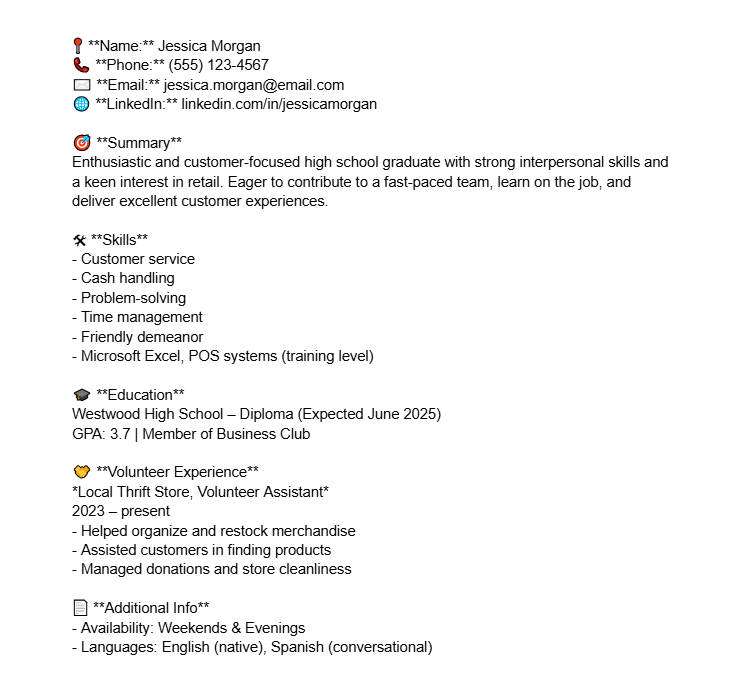
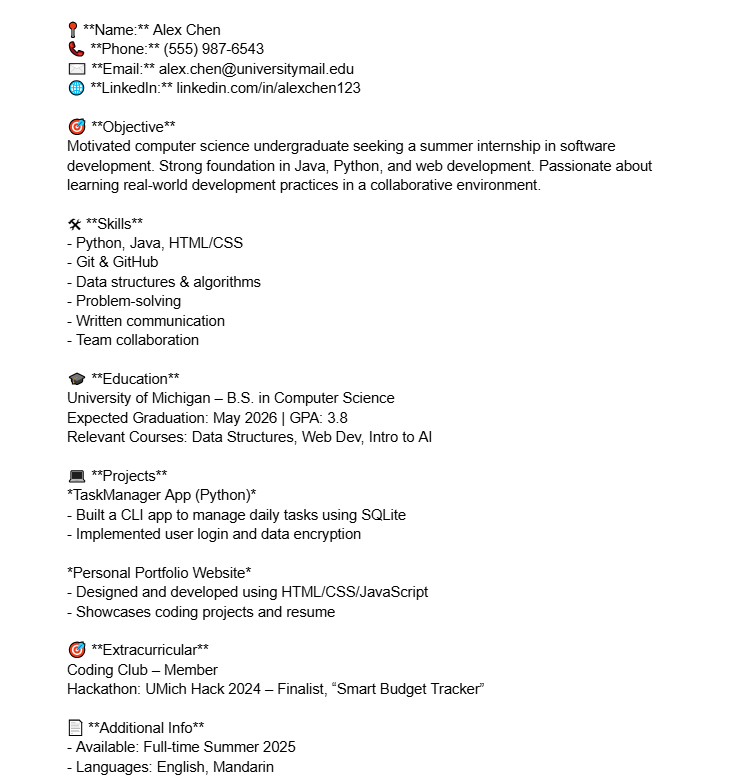
These templates were designed by HR experts who regularly review entry-level resumes.
They’re ATS-friendly and built to get past filters and into human hands. Clean structure wins over design every time.
https://docs.google.com/document/d/1ZbDNq2ILN-JNRvExuAMyFm3OMR4Invt4C37zzSMHr_M/copy
https://docs.google.com/document/d/11Q0T2tCDyIw7uuIaC9vG1xPduEUhOhA5PpvEDdBpERI/copy
Copy-Paste Resume Template (ATS-Friendly)
[YOUR NAME]
[Phone] | [Email] | [City, State] | [LinkedIn]
SUMMARY
Motivated entry-level candidate seeking [job title]. Strong in [2–3 key skills].
Known for [trait] and ability to [result].
SKILLS
- [Skill 1] (e.g., Customer Service)
- [Skill 2] (e.g., Microsoft Excel)
- [Skill 3] (e.g., Communication)
- [Skill 4] (e.g., Time Management)
PROJECTS
[Project Name]
- What you did + tool used + result
- Example: Created a budget tracker in Excel to manage monthly expenses
[Project Name]
- What you did + outcome
- Example: Led group presentation, improving team grade to A
VOLUNTEER EXPERIENCE
[Organization Name] — [Role]
- What you did + impact
- Example: Assisted 50+ clients weekly at local food bank
EDUCATION
[School Name], [City]
[Diploma/Degree], [Graduation Date]
(Optional: GPA, relevant coursework)
CERTIFICATIONS
- [Certification Name]
How to Use This Template (No Guesswork)
- Replace everything in brackets with your info – don’t leave placeholders.
- Match the job description: If the role asks for “customer service,” that exact phrase goes in your skills.
- Turn activities into proof: School, volunteering, or personal projects = experience.
- Keep bullet points results-focused: What you did + how + outcome. Even small wins count.
- Don’t over-design: No tables, graphics, or columns.
Use this template as a base, not a script. Adjust it to the job you want, and you’ll already be ahead of most entry-level applicants.
Top Skills Employers Look for in Entry-Level Candidates
In every career field, employers look for pretty much similar traits in entry-level applicants. They hire you for how fast you’ll become useful. That means your skills section needs to show behavior + proof, not generic buzzwords.
Here are the top skills an entry-level resume should have.
Soft Skills (How You Work)
- Fast Learning / Adaptability: “Learned new POS system in 2 days and handled transactions independently”
- Communication: “Explained product options to customers, helping them make purchase decisions”
- Customer Focus: “Assisted customers with questions, improving satisfaction during busy hours”
- Reliability / Work Ethic: “Maintained 100% on-time attendance during school term and part-time work”
- Problem-Solving: “Resolved scheduling conflict in team project, ensuring on-time submission”
- Teamwork: “Collaborated with 4 team members to complete group presentation with top grade”
Hard Skills (What You Can Do)
- Microsoft Office / Google Workspace: “Built Excel spreadsheet to track and analyze monthly expenses”
- Basic Tech / Digital Skills: “Created presentations in PowerPoint and managed shared files in Google Drive”
- Programming / Technical (if applicable): “Built a simple website using HTML/CSS for class project”
- Social Media / Content: “Managed school club Instagram page, increasing engagement by 30%”
Transferable Skills (Your Hidden Advantage)
- Organization / Time Management: “Balanced coursework and extracurriculars while meeting all deadlines”
- Leadership (even informal): “Led a 3-person team project, assigning tasks and coordinating final delivery”
- Initiative: “Started a peer study group that improved exam performance”
- Attention to Detail: “Reviewed and edited team reports to ensure accuracy and consistency”
Common Mistakes to Avoid
When you start out, small resume mistakes can cost you big opportunities. Here are the most common pitfalls – and how to fix them.
1. Typos and Grammar Errors
Mistake: Spelling mistakes or poor grammar make you look careless.
Fix: Proofread multiple times and use tools like Grammarly.
2. Using Generic Statements
Mistake: Phrases like “hardworking” or “team player” without proof.
Fix: Add context and results.
3. Lack of Structure
Mistake: A cluttered or inconsistent layout.
Fix: Use clear sections (Education, Skills, Projects) and consistent formatting (same font, spacing, bullet style).
4. Including Irrelevant Information
Mistake: Listing hobbies or details that don’t add value.
Fix: Only include activities that demonstrate transferable skills (leadership, communication, initiative).
5. Focusing on Duties Instead of Skills
Mistake: Describing what you did instead of what you learned or achieved.
Fix: Highlight outcomes and skills gained.
6. Skipping a Summary or Objective
Mistake: Starting abruptly without context.
Fix: Add a short 4–6-line objective tailored to the role, showing motivation and relevant strengths.
7. No Keywords from Job Description
Mistake: Ignoring keywords used by employers (important for ATS systems).
Fix: Mirror key skills and terms from the job posting naturally in your resume.
8. Overloading with Text
Mistake: Long paragraphs that are hard to scan.
Fix: Use bullet points, keep descriptions concise, and aim for one page.
9. Using an Unprofessional Email Address
Mistake: Emails like “coolguy123@email.com.”
Fix: Use a simple format: firstname.lastname@email.com.
10. Not Showcasing Projects or Volunteer Work
Mistake: Leaving your resume empty due to lack of formal experience.
Fix: Include academic projects, internships, or volunteer work to demonstrate real skills.
Avoiding these mistakes helps your resume look polished, professional, and ready to compete.
How to Make Your Resume Stand Out Without Experience
Even without formal work experience, you can create a resume that grabs attention by focusing on how you present your potential, not just your past.
1. Use Metrics to Show Impact
Numbers make your contributions tangible and credible.
Example: Instead of “Helped organize an event,” write:
“Co-organized a student event attended by 80+ participants, managing logistics and promotion.”
Tip: Think in terms of scale (numbers), time (deadlines), or results (improvement %).
2. Turn Activities into Achievements
Reframe schoolwork, projects, or volunteering as accomplishments.
Example: “Developed a social media campaign for a class project, increasing engagement by 30% in 2 weeks.”
This shows initiative, creativity, and measurable success.
3. Tailor Every Resume to the Job
Avoid sending the same resume everywhere.
What to do: Adjust your skills and wording based on the job description.
Example: If a role requires communication skills, highlight presentations, group work, or customer interaction experience.
4. Use a Strong Personal Statement
Start with a brief summary that highlights your strengths and goals.
Example: “Motivated business graduate with strong analytical and teamwork skills, eager to contribute to a fast-paced marketing team.”
5. Highlight Transferable Skills
Focus on skills gained from academics, extracurriculars, or life experience.
Examples: Leadership (team captain), organization (event planning), problem-solving (projects).
6. Add a Projects Section
Projects can substitute for experience when presented correctly.
Example: “Built a personal budget tracker using Excel, improving expense tracking accuracy and financial awareness.”
7. Show Personality Through Storytelling
Use bullet points that tell a brief story of action + result.
Example: “Identified gaps in group workflow and introduced a shared task system, improving team efficiency.”
A standout resume isn’t about having experience – it’s about clearly showing your value, initiative, and potential in a way employers can’t ignore.
Quick Resume Checklist
Use this final scan before hitting “apply”:
- Clear structure: Sections include Education, Skills, Projects, and (if relevant) Volunteer Work
- Tailored content: Resume matches keywords and requirements from the job description
- Strong summary/objective: 4-6 lines showing your goals and key strengths
- Relevant skills only: Focus on transferable skills (communication, teamwork, problem-solving)
- Projects included: At least 1–2 projects with action + result statements
- Metrics used: Numbers added where possible (e.g., “led team of 4,” “completed in 2 weeks”)
- Concise format: Bullet points, no long paragraphs, ideally one page
- Consistent design: Same font, spacing, and formatting throughout
- No errors: Spelling and grammar carefully checked
- Professional details: Appropriate email address and updated contact information
If you can check all of these, your resume is ready to compete.
Get Expert Feedback on Your Resume
Sometimes, a small change can make a big difference. Getting a second pair of eyes on your resume helps you spot gaps, strengthen your wording, and present your skills more effectively – especially when you don’t have formal experience yet.
With expert feedback, you can:
- Turn basic descriptions into strong, results-focused statements
- Identify missing skills or sections that employers expect
- Improve clarity, structure, and overall readability
- Tailor your resume more precisely to your target roles
- Professionals who review resumes every day understand what hiring managers look for and how applicant tracking systems (ATS) work.
If you’re unsure whether your resume is “good enough,” getting feedback is a simple, low-pressure way to gain confidence and make meaningful improvements before you apply.
Expertise by Industry
Entry-level hiring follows the same pattern across industries: employers don’t expect experience, but they do expect relevant signals. That’s why school projects, volunteer work, and basic responsibilities work, if they match the role.
Our student clients often focus on volunteer work and school projects and that works perfectly for entry applications.
We’ve seen this apply across retail, customer service, admin, and junior tech roles. The candidates who get interviews aren’t the most experienced – they’re the ones who align their skills with the job description and show proof.
If you’re unsure whether your resume does that, that’s the real risk. Employers won’t explain what’s wrong; they’ll just move on to someone clearer.
FAQ Section
1. What to put on a resume with no experience?
Focus on proof, not job titles. Include skills, education, projects, volunteer work, and activities. Show what you’ve done and the result.
Example: “Organized school event for 50+ attendees”.
2. Do I need a resume for my first job?
Yes. Most employers still expect one, even for part-time or entry-level roles. It shows you’re serious and helps them compare candidates quickly.
3. What skills should I include?
Only skills relevant to the job. Pull keywords from the job description. Mix hard skills (Excel, social media) with soft skills (communication, teamwork), but support them with examples.
4. How long should a no-experience resume be?
One page. No exceptions. If you can’t keep it to one page, it will be fluff instead of value.
5. What if I have nothing to add?
You do. You just ignore it. School projects, group work, volunteering, helping family, even organizing events – all count. The issue isn’t lack of experience; it’s lack of framing.
6. Should I include hobbies or interests?
Only if they add value or show something relevant (teamwork, discipline, creativity). Random hobbies won’t help, but strategic ones can.
7. Do I need a cover letter for my first job?
Not always, but it helps. A short, targeted cover letter can explain your motivation and make up for limited experience, especially if your resume is basic.
Get Professional Help Crafting Your First Resume
When applying for entry-level jobs, you have to compete with your peers and career changers. The entire process of job-hunting might get frustrating as you keep getting rejections.
If you’ve sent out applications and heard nothing back, your resume is probably the problem, not your lack of experience. Most entry-level resumes fail because they’re vague, unfocused, or don’t match what employers are scanning for.
Quite often the situation can be changed after a simple resume rewriting. A professional resume review helps you spot weak sections, tighten your wording, and position your skills in a way that actually makes sense to hiring managers.
Sometimes small changes like reframing projects or sharpening your summary make the difference between getting ignored and getting interviews. We offer personal help of your resume assistant who will work on your resume until it's perfect.
If you’re stuck or unsure whether your resume is “good enough,” getting expert feedback is a practical next step. You don’t need a complete rewrite, you need clarity, structure, and proof that what you’ve written works.
Author: Editorial Team at ResumePerk.com
Reviewed by: Certified Career Expert
Last updated: November 2025
Recommended reading:
- Write Your Resume Like an Expert Resume Writer: 10 Tips
- How to Build My Resume Effectively In 10 Simple Steps