Relocation Cover Letter Examples (And How to Write One Employers Trust)

Relocation in a cover letter is often treated as a minor detail. In practice, it is not. Many employers are cautious when they see an out-of-town candidate. The hesitation is predictable.
Relocation creates perceived risk. Questions about commitment, timing, and cost appear immediately. Is the move definite or conditional? Will the candidate delay the start date? Could they reconsider if circumstances change? Some hiring managers have dealt with withdrawn acceptances after relocation plans fell through, so the concern is not theoretical.
If this uncertainty is not addressed, it quietly influences shortlisting decisions. Especially when local candidates are available.
Why Employers Are Cautious About Relocation Candidates
Relocation signals three main risks: unstable commitment, unclear timing, and potential expense. Employers may assume the move depends entirely on receiving the offer. They may worry about delayed onboarding. They may also expect future negotiations around relocation support.
These concerns can be reduced. The following sections explain when relocation should be mentioned and how to present it without increasing perceived risk.
Should You Mention Relocation in a Cover Letter?
Yes, but not automatically. Whether you mention relocation depends on how visible it already is in your application and whether it could raise questions for the employer. If your address clearly shows you live in another city or country, ignoring relocation may create uncertainty. In other situations, mentioning it too early can shift attention away from your qualifications.
In practice, the goal is simple: remove confusion without turning relocation into the main story of the letter.
When you should mention relocation
You should address relocation if the employer will immediately notice that you are not local.
Example 1:
Your resume lists a current address in another state or country. If the job is clearly location-based, the employer will assume relocation is required.
Example 2:
You already have a confirmed move planned. For instance, you are relocating in July because your partner accepted a job in the city.
In these cases, briefly acknowledging relocation helps remove the question of whether the move is realistic.
When it’s better to skip it
Sometimes mentioning relocation creates a concern that did not exist before.
Example 1:
You are applying to remote roles where location does not affect the work arrangement.
Example 2:
Your resume already lists a local address because you are moving soon or staying temporarily in the area.
In these situations, bringing up relocation can distract from your qualifications and raise logistical questions unnecessarily.
Where to place it in the letter
If relocation needs to be mentioned, placement matters.
Example 1:
In the opening paragraph when the location difference is obvious. This prevents the reader from wondering about it while reviewing the rest of the letter.
Example 2:
In the second paragraph after briefly introducing your experience. This works when relocation is relevant but not the central issue.
In both cases, the reference should stay brief. The letter still needs to focus primarily on your skills and the role itself.
How to Write a Relocation Cover Letter (Step-by-Step)
The objective of writing a relocation letter is to bridge the gap between your current location and your target market. For example, if you work in New York City but dream about Los Angeles, the relocation letter is your chance to get a job in California. If you want to write a strong letter explaining your relocation, follow these practical steps.
Address the relocation concern early (if needed)
Start with a compelling intro. You should open your letter with a tailored opening that clearly states the role or position you are applying for. Your goal is to show how enthusiastic you are about that position and how ready to relocate. The first paragraph should also provide some information about your best achievements and qualifications.
In some cases, relocation should be addressed immediately. If your current location is far from the job, acknowledging it early prevents the reader from wondering how realistic the move is.
Show commitment to moving
Explain your relocation clearly. The next paragraph should explain your relocation plans. Here you can write about your motivation for relocation. You need to assure your employer that your relocation plans are well-written and you are ready to make that step. You should also mention that all logistical arrangements are your concern.
Mention your ties to the new city. This point is important if you have friends or family members in a new area. Thus, you will demonstrate your readiness for a long-term relocation. If you have no family members, but you are well aware of the local market or have local customers, you should mention that too. Your relocation should be justified with a solid reason, preferably a professional one.
Remove employer risk
Use confident language. Throughout your letter, you should use a very confident tone. You need to illustrate that you have no doubts or concerns about your relocation. You should not use any apologetic phrases. Instead, you should demonstrate readiness to move and your willingness to contribute to the company's growth.
Clarity about logistics also reduces concerns. If appropriate, you can briefly mention that the move is planned, financially prepared, or already scheduled.
Refocus on your value, not the move
Close with a clear CTA. Finally, end your letter with a call for action. For example, if your relocation is not yet approved, you may end your letter with a statement of interest in discussing the position further. You can offer a call or even a meeting, if that is suitable. You should also reaffirm your enthusiasm about the relocation by the end of the letter.
Still, the main takeaway should not be the move itself. Your reader should have a clear understanding of your qualifications and the next step you expect.
Relocation Cover Letter Examples (With Explanations)
These samples are tailored for various situations: career moves, following a spouse, and changing states. If you want to be a perfect candidate for the job, you need to mention not only your move date or the current location, but also send your moving-related job application to the right person. Relocation means new career opportunities, and you can gain extensive experience by utilizing an opportunity to build a career in a new place.
Template #1 - Personal Initiative
[Your Name]
[Current Address]
[City, State ZIP Code]
[Phone Number]
[Email Address]
[Date]
[Hiring Manager's Name]
[Company Name]
[Company Address]
[City, State ZIP Code]
Dear [Hiring Manager's Name],
I'm writing to express my interest in the [Job Title] position at [Company Name], recently advertised on [Job Board/Company Website]. I will be relocating to [Target City] in [Month/Date] and am excited about the opportunity to bring my skills and experience to your team.
With [X] years of experience in [Your Field], I've developed [key skills], which I believe make me a strong candidate for this role. My recent work at [Previous Company] involved [relevant achievement or responsibility], which aligns well with your company's goals.
I am enthusiastic about contributing to your team in [Target City], and I'm available for virtual interviews or can travel if needed. Thank you for considering my application. I look forward to the opportunity to speak further.
Sincerely,
[Your Name]
Why this works
This version addresses relocation immediately and provides a clear timeline. The employer does not need to guess whether the move is hypothetical or planned. The letter quickly shifts back to experience and achievements, so relocation stays contextual rather than becoming the main topic.
What concern it addresses
The template reduces uncertainty around timing and seriousness. By stating the relocation date early, it reassures the employer that the move is already planned rather than dependent on getting the job.
Template #2 - Relocation to support your spouse
Dear [Hiring Manager's Name],
I am reaching out to express my interest in the [Job Title] opening at [Company Name]. My family is relocating to [Target City] this summer due to my spouse's job transfer, and I'm seeking a new professional opportunity in the area.
As a [Your Current Job Title] with [X] years of experience, I bring expertise in [mention skills or industry]. At [Previous Company], I [achievement or responsibility relevant to new job].
Though I am new to the area, I'm eager to become part of a community-driven organization like [Company Name]. I'm available to begin work as early as [Date] and would be happy to interview virtually in the meantime.
Thank you for your time and consideration.
Sincerely,
[Your Name]
Why this works
This template gives a concrete reason for relocation. Mentioning a spouse’s job transfer signals that the move is already decided and not tied to this particular application. The rest of the letter keeps the focus on professional experience.
What concern it addresses
Employers sometimes worry that candidates might cancel relocation plans if the job search becomes difficult. A family-related move usually indicates a stable and non-negotiable relocation timeline.
Template #3 - No connections with the new city
Dear [Hiring Manager's Name],
I am writing to apply for the [Job Title] position at [Company Name]. I am planning to relocate to [Target City] and am impressed by your company's reputation and innovative work in [industry/area].
While I do not currently reside in [Target City], I am actively planning my move and am prepared to relocate at my own expense. I bring [key experience] in [relevant area], including [notable project or result]. I'm confident I can contribute value to your team from day one.
I welcome the chance to speak with you further and can be available for video interviews at your convenience.
Thank you for considering my application.
Best regards,
[Your Name]
Why this works
This version openly acknowledges the lack of local ties instead of avoiding the issue. It also clarifies that relocation logistics and costs are already considered by the candidate, which keeps the message straightforward.
What concern it addresses
The main concern here is financial and logistical risk. By stating readiness to relocate at personal expense, the letter reduces the expectation that the employer will need to sponsor or organize the move.
Common Relocation Cover Letter Mistakes
Relocation itself is not usually the main problem in a job application. The problem is how it is presented. From an employer perspective, relocation introduces uncertainty, and small signals in a cover letter can quickly increase or reduce that uncertainty. Some mistakes appear harmless to the candidate but raise practical concerns for hiring managers reviewing dozens of applications.
Sounding unsure
One common issue is language that makes relocation sound uncertain. Phrases such as “I’m considering relocating” or “I might move if the opportunity is right” suggest that the decision is still unresolved. From an employer perspective, this creates doubt about commitment and timing.
The consequence is simple: employers may prefer a local candidate whose availability feels more predictable. Even if your experience is strong, uncertainty about relocation can make the application appear less reliable.
Asking about relocation support too early
Another mistake is raising relocation assistance or compensation in the cover letter. While relocation support can be a legitimate topic later in the process, bringing it up in the first contact changes the tone of the conversation.
From an employer perspective, this can shift attention from your qualifications to potential costs. The consequence is that the employer may assume relocation will require additional resources and decide to move forward with applicants who appear simpler to hire.
Making relocation the main topic
Some candidates focus most of the cover letter on explaining their move. They describe the city, personal motivations, or detailed relocation plans. However, the purpose of the letter is still to demonstrate professional value.
From an employer perspective, excessive focus on relocation can overshadow the candidate’s skills and achievements. The consequence is that the employer may finish reading the letter without a clear understanding of why the candidate is a strong fit for the role.
Tips to Make Your Job Transfer Letter Stand Out
- Highlight your connection with an area
If you have previously lived or studied in the town or have a family member living there, be sure to inform the potential employer about it. This will let them know that you are familiar with the location and will take less time to accommodate a new environment. Looking for a job remotely often means that you'll have to pass a lot of phone interviews. Learn how to do a phone interview in the right way. This information should also be mentioned during in person interview. - Explain your reason for relocation
If the company isn't specifically hunting you, they will be cautious when dealing with candidates applying remotely, and that's a normal practice. To convince the employer that you're a safe bet, you need to give a grounding for your relocation. If you relocate for personal reasons (better climate, moving for your spouse, etc.), give the employer a solid reason that has motivated you to relocate. Highlight that you are moving permanently and are looking for a long-term, full-time position. If you're willing to move because of a higher salary and better career prospects, be sure to emphasize your dedication to your career. The a compelling application letter piques the reader's interest of the reader and yet does not leave too many open questions. - Show that you've done the research
When creating a job application when planning a move, you should be as specific about the company and the location as possible. Before writing that letter, do your research on the company and demonstrate your knowledge of the company, its challenges, and its products in your letter. Additionally, you can highlight your knowledge of the area and its perspectives for your career, if any, to demonstrate that you are serious about your relocation decision. Find a sample letter guide online to get a better idea of how to write a great letter. A perfect letter sample will save you a wealth of time. - Downplay the location factor
If you're not aiming for a top-level role where companies are willing to attract qualified candidates at all costs, you might need to do some extra work to downplay the fact you're located in another state. One of the popular tricks is to use a local address. However, be aware that if you've indicated a local address, the employer won't compensate your travel expenses if you're invited for an interview, and the chances are that you'll have to fly for an interview in a rush. The better tactic is to say that you're already in the middle of the relocation process and, if you want that job at all costs, you can also mention that you're willing to relocate at your own expense. Therefore, you minimize the employer's expenses for hiring and your candidacy will be more welcomed. - Make your letter flawless
Ideally, upon a letter review the hiring manager should reach out to their phone and invite you out for an interview. Although such cases are rare, a well-written letter increases your chances of getting an interview call. So, you should put extra effort into composing the letter until it's perfect in all aspects. Include your most important and relevant experience and highlight the accomplishments to show your orientation at the result.
There are several ways to mention relocation in your letter - use the method that fits your career situation and company time best. In some cases, one sentence in an opener is enough, and sometimes you'll need to expand on the issue for a few sentences. Therefore, choose a relocation letter template that meets your needs the most.
Here are some helpful articles to read before you start writing your relocation letter.
- Avoid common resume mistakes
- Use powerful resume words
- Address relocation early and clearly
Relocation Cover Letter FAQ
Is relocation a red flag for employers?
Not automatically, but it can raise practical questions. Employers may wonder about commitment, timing, and whether the move depends on getting the job. If relocation is clearly planned and communicated briefly, it usually stops being a concern.
Do I need to mention relocation in every cover letter?
No. You should mention it only if your current location could create confusion. For example, if your resume shows an address in another city or country. If the role is remote or your resume already shows a local address, bringing up relocation may be unnecessary.
Should I include my moving date?
If you already have a confirmed timeline, including a moving date can help. It shows that the relocation plan is concrete and not hypothetical. If the timing is still flexible, it is usually better to state your readiness to relocate rather than give an uncertain date.
Relocation letter sample
Now that you are aware of the ways to talk about your move in a job application, take a look at a good example:
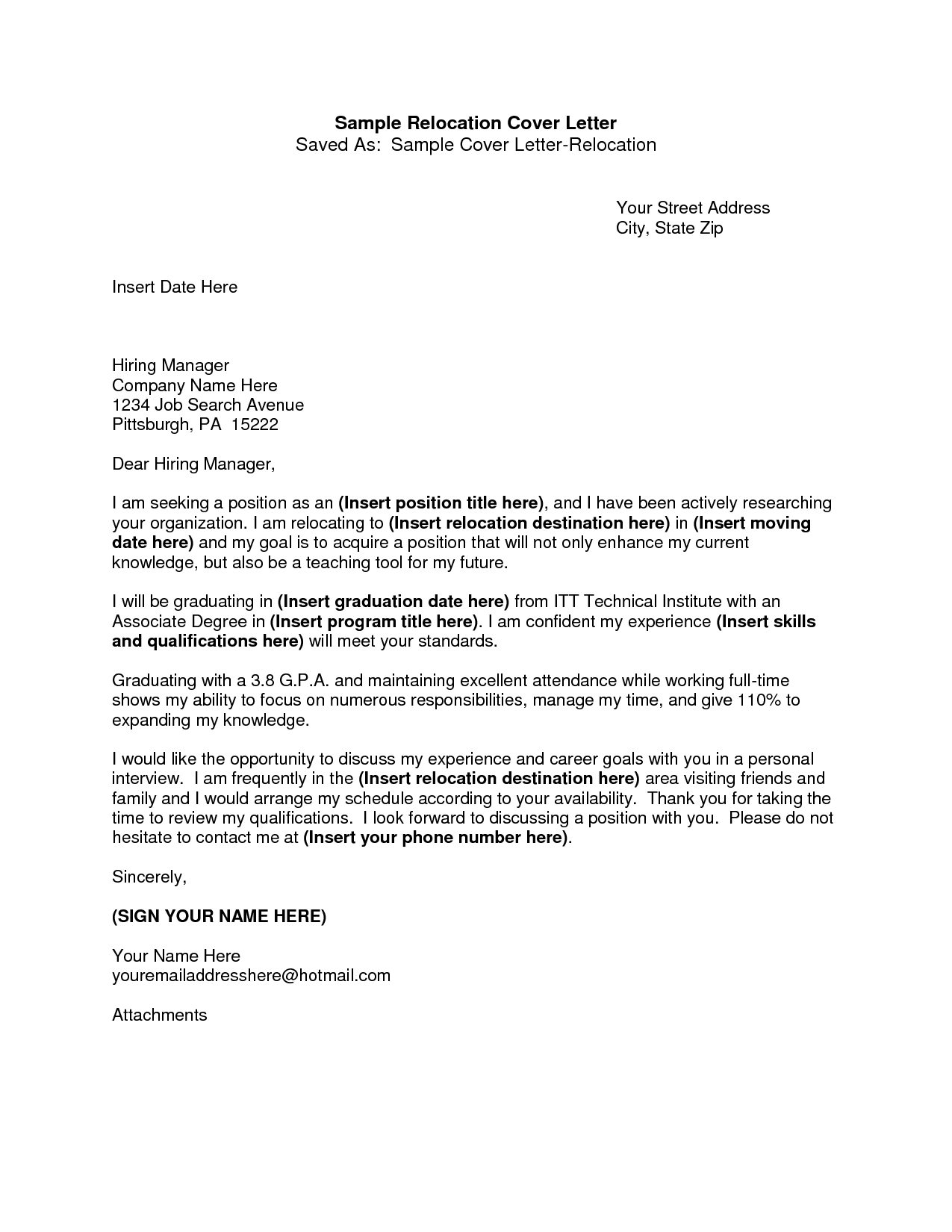
Image source: /uploads/2092/images/2f96828b507edb4ab5dffe44a76745cc.png
Note that this candidate mentions the relocation issue right up front so that the hiring manager will continue reading the letter even though the candidate is located in a different state. After that, the job-seeker lists their strengths and excellent academic performance, which, in their opinion, will be beneficial for the organization. And finally, they show their familiarity with the area and willingness to attend face-to-face interviews whenever it's convenient for an employer.
How to write a relocation letter: Key takeaways
Above, we've outlined the process of writing a relocation letter for any profession. Use any sample letter for job relocation as a reference to format your own. If you have no time to read, here are the principles of writing a relocation letter summarized:
- Talk about your planned move early in the letter or the last one. The first paragraph is best for companies that routinely relocate talent, or when you are relocating anyway and are simply informing the potential employer about this fact. If you want to discuss relocation in detail or negotiate relocation costs, write about it in the last paragraph.
- Show your connection with the area or employer. If you studied in the city you're planning on moving to, have family there, or relocate with a spouse, include it in your cover letter. Having personal motivation increases your chances of being considered.
- Don't make relocation a central point. The your move is worth noting, but, but you want to focus more on what makes you a fit for the role. Include achievements, relevant skills, and experience that prove your qualifications. Find an example that matches your exact situation!
- Be concise and attentive to detail. Keep it to one page or 3-4 short paragraphs. Proofread the letter to exclude any occasional mistakes, and double-check your name and contact details. Do not forget to add a proper letter ending.
Need Help Writing a Relocation Cover Letter?
If you want a second opinion before sending your application, a professional review can help clarify how your relocation is presented and whether anything might raise concerns for employers. Even small wording choices can create the wrong impression. Getting your cover letter edited or written by experienced reviewers can help you avoid common relocation mistakes and present your message more clearly.
Author: Editorial Team at ResumePerk.com
Reviewed by: Certified Career Expert
Last updated: March 2026
Recommended reading:
Alison is a certified resume writer and career consultant (CPRW, NCRW, NCOPE, CCTC) with 10+ years of experience crafting ATS-optimized resumes, cover letters, and LinkedIn profiles. She helps professionals across industries secure interviews at Fortune 500 companies by combining recruiter-validated strategies with modern job-search expertise.